Independent Agricultural Research
Smarter Soil.
Better Decisions.
LupaIQ is an independent precision agriculture initiative developing intelligent soil analysis technologies that help farmers, researchers, and communities make better land management decisions.
The Platform
This part is built and working
A real screenshot, not a mockup: sample points interpolated into a field surface, clipped to the boundary the grower draws, with every measured type readable at any point on the map. The readings behind it are simulated — the software is finished in a way the measurement chain is not.
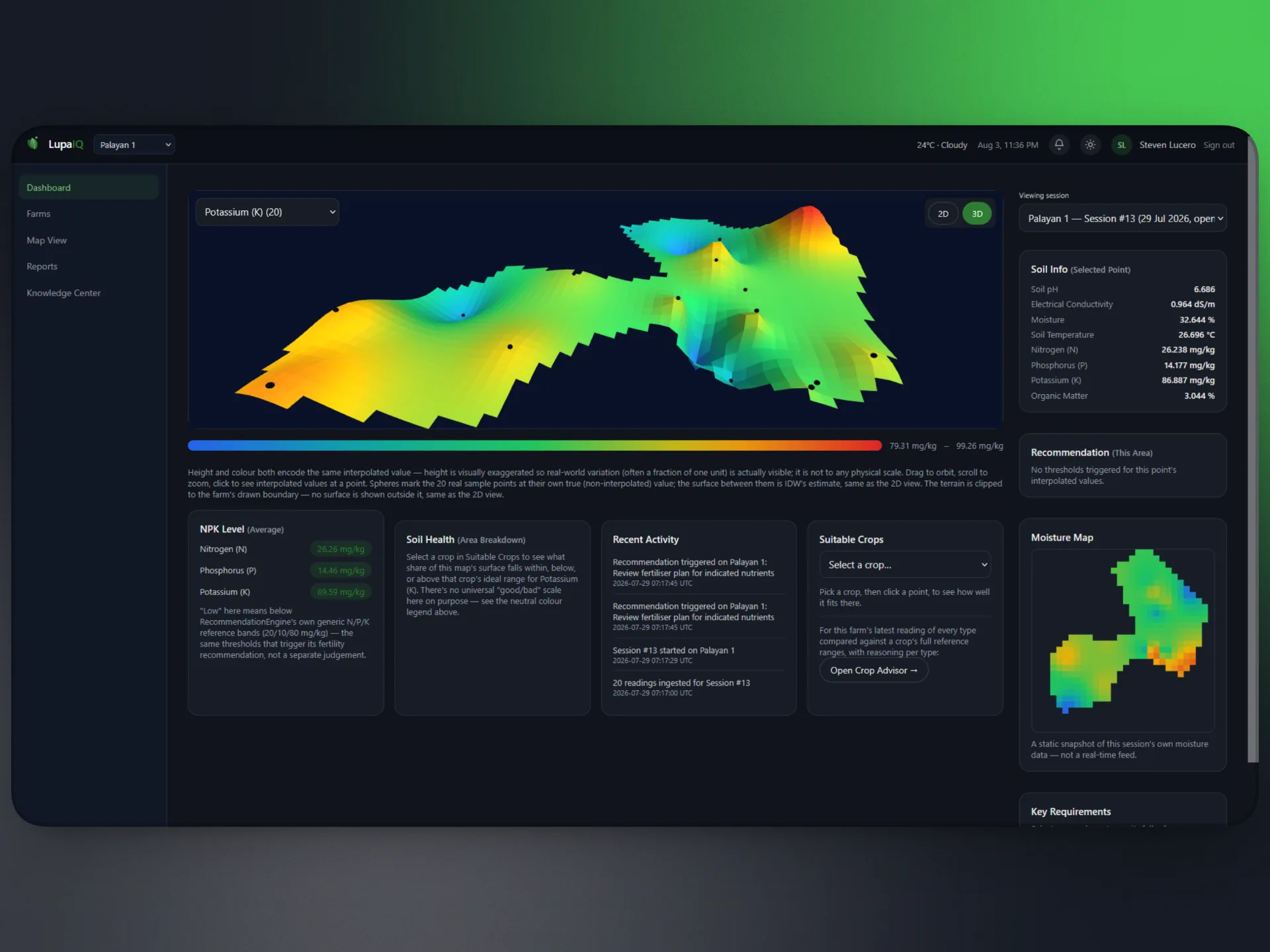
LupaIQ Soil Mapping System, running on simulated sensor data. No reading shown here came from a physical probe in a real field.
Current Stage
Where the project stands today
LupaIQ is being built in the open. The software platform is finished and working; the sensor hardware that is supposed to feed it is not. This is an accurate picture of both.
Complete
Research & Design
Reviewing soil sensing literature, agronomic models, and the measurement limits of low-cost instrumentation.
Complete
Software Platform
Built and working end to end: ingestion, interpolated soil mapping, rules-based recommendations, and crop comparison — running on simulated sensor data.
Current stage
Sensor Integration & Field Validation
Connecting real probe hardware to the ingestion pipeline, then comparing its readings against laboratory soil analysis to establish where the system is and is not reliable.
Upcoming
Pilot Deployment
Documenting protocols and partnering with farms willing to host a structured, measured trial.
LupaIQ is currently in its research and pilot phase. Commercial services are not yet available.
Our Mission
Help farmers make better decisions using data instead of guesswork
Soil is not uniform, and the cost of treating it as though it were is paid twice — once in wasted input, and again in the parts of a field that needed something else.
Replace guesswork with measurement
Most fertiliser decisions are made from habit, appearance, or advice that was never matched to the specific field it is applied to. Measurement narrows that gap.
Improve fertiliser efficiency
Applying the right input to the right part of a field is a question of information. Knowing where nutrients are already sufficient is as useful as knowing where they are not.
Support more sustainable practice
Nutrients applied beyond what a soil can hold do not stay in the field. Reducing avoidable excess is good for the land and for the watershed below it.
Reduce unnecessary cost
Inputs are one of the largest controllable expenses in a growing season. Better information helps direct that spending where it is likely to matter.
What We Are Building
A connected set of tools for reading soil
Each component is at a different stage, and the labels below say which. Everything marked Built exists and runs today — on simulated readings, which is the honest limit of what any of it currently proves.
Soil Intelligence
A structured record of what was measured in a field, where, when, by which sensor, and under what calibration state. Every stored reading is traceable to the conditions it was taken under — without that, later analysis cannot be trusted.
Built
GIS Visualisation
Sample points interpolated into a continuous surface, rendered in 2D and as a 3D terrain, clipped to the farm boundary the grower draws. Variation becomes something you can see rather than read out of a table.
Built
Recommendation Engine
A readable set of agronomic threshold rules, where every output traces to one measured value and one stated threshold. It reports nothing when nothing is triggered, rather than manufacturing a recommendation from a weak signal.
Built
Decision Support
Click anywhere on a field surface to see every measured type at that point, which rules fire there, and how the result compares against a chosen crop's reference ranges — with the decision left to the person who knows the field.
Built
pH Analysis
Soil acidity strongly governs whether nutrients already present are actually available to a crop. It is among the most reliable measurements we can take, and it drives the liming rules directly.
Built
Electrical Conductivity
EC responds to salinity and total dissolved ions, and is a useful proxy for variation across a field — provided moisture and temperature are accounted for.
Built
Moisture Mapping
Moisture affects nearly every other reading. Capturing it is partly about the soil itself and partly about correctly interpreting everything measured alongside it.
Built
Historical Field Records
Readings are grouped into survey sessions, so the same field can be measured again next season and compared rather than overwritten. Single readings say little; the trend is where the value accumulates.
Built
NPK Mapping
Spatial representation of nitrogen, phosphorus, and potassium indicators across a field. The mapping works; nitrogen in particular is inferred rather than measured directly, and calibrating that inference is hardware work still ahead.
Under development
Predictive Analytics
A longer-term direction, and one that requires several seasons of validated field data before it could be attempted responsibly. Nothing here is being trained on simulated readings.
Planned
Why LupaIQ
The problems we are trying to help with
These are well documented in agronomic literature and familiar to anyone who farms. What follows is what each problem is, and what better information can realistically contribute — not a claim that measurement solves it.
- 01
Uneven soil conditions
A single field is rarely uniform. Slope, drainage, past cropping, and organic matter produce conditions that vary metre to metre, while inputs are typically applied as though they do not.
Measuring at multiple points makes that variation visible, which is the precondition for treating parts of a field differently.
- 02
Overfertilisation
Applying more than a soil can hold rarely improves outcomes. The surplus is lost to leaching or runoff, and in some cases suppresses uptake of other nutrients.
Knowing which areas are already sufficient identifies where additional input is unlikely to help.
- 03
Underfertilisation
The reverse is equally common, and harder to notice — a deficiency can limit a crop well before it produces any visible symptom.
Regular measurement can surface a shortfall while there is still time in the season to respond to it.
- 04
Hidden nutrient imbalance
Nutrients interact. Adequate phosphorus is of little use at a pH where the crop cannot take it up, and excess potassium can interfere with magnesium uptake.
Reading nutrients alongside pH and conductivity gives a picture that a single-value test cannot.
- 05
Manual guesswork
Laboratory analysis is accurate but slow and costly enough that most smallholders use it rarely, if ever. The gap is filled by estimation and inherited practice.
Faster, lower-cost indicators do not replace laboratory work — but they can make the time between proper tests far less blind.
We do not claim that using LupaIQ will increase yield. Harvest depends on weather, seed, timing, pests, labour, and many factors no soil sensor observes. What better information can do is make a decision less blind.
Work with us
We welcome conversations with organisations and individuals interested in advancing precision agriculture — including farmers willing to host a trial, researchers who can challenge our methodology, and institutions working on the same problems.