Saklolo PH puts your local police, fire, ambulance and barangay tanod numbers on your phone and keeps them there. When seconds decide the outcome, it removes the hand-offs between you and the people who actually drive to your address.
The resident taps once on their phone. The responders watching the municipal monitor see the request appear, with a location, before anyone has spoken.
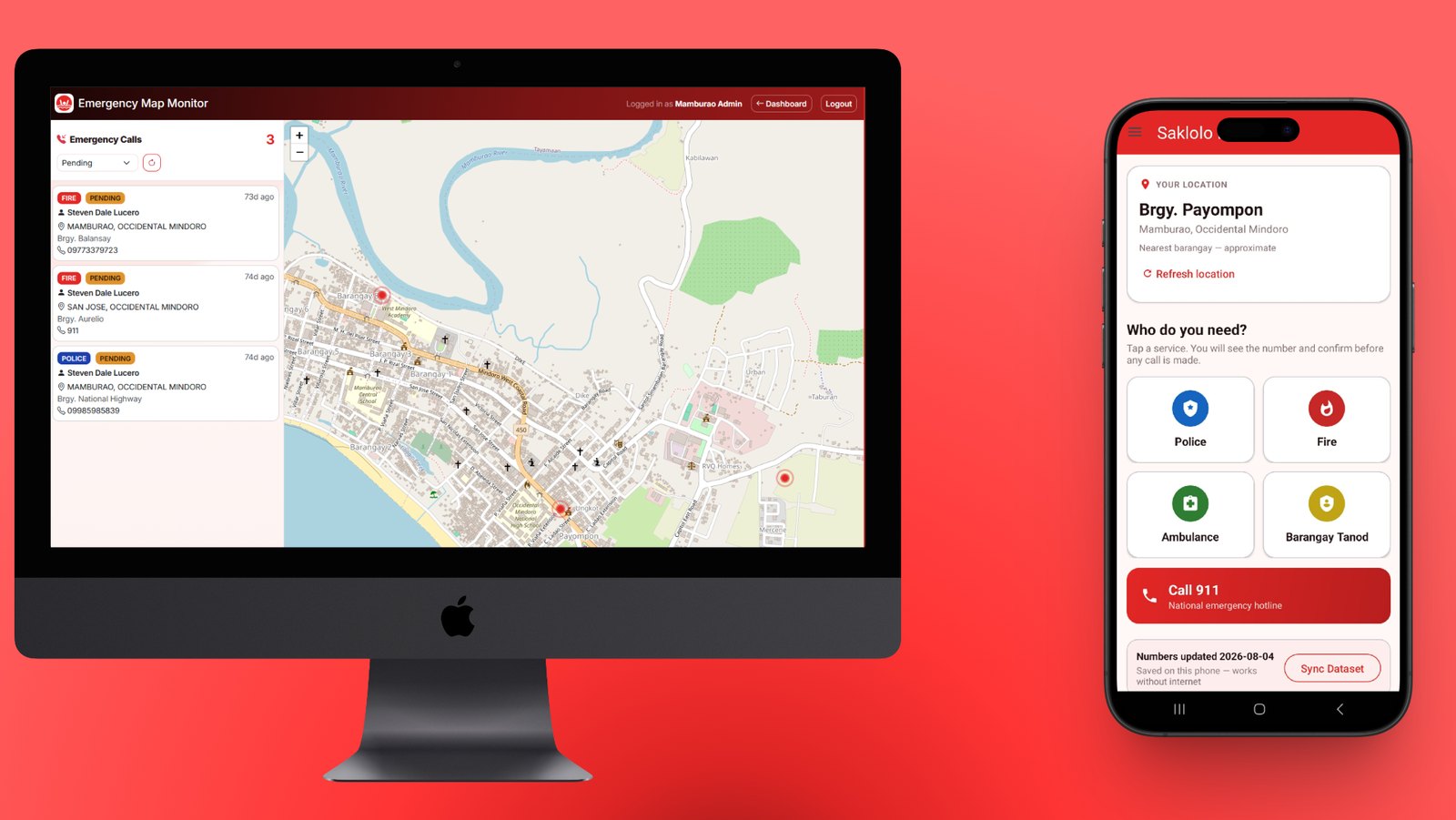
Left: what the LGU sees. Right: what the resident taps.
How a request finds the nearest responder. A resident on the move asks for barangay tanod support. Three tanod stations are in range — the request goes to the closest one, which deploys its own team. No hand-off, no re-explaining. Illustrative animation · 20 seconds · no sound
Police, fire, ambulance or barangay tanod — one tap from the home screen.
GPS is compared against barangay coordinates to find who is genuinely closest.
When online, the request appears on the monitor with the caller and a map pin.
Responders act on the location already in front of them.
911 did something genuinely valuable: it collapsed roughly thirty separate local emergency numbers into one that every Filipino can remember. That is the right idea. But a single national entry point means a call still has to travel down to the responders who are physically near you.
Each step is another person, another queue, and — for the caller — often another retelling of what is happening.
911 stays the number everyone should know, and the one to call when you are unsure. What Saklolo PH does is take some weight off a nationwide hotline while getting help moving sooner, by dialling the responder who is already closest to you.
Install once, sync once. The emergency directory is stored on the phone itself, so a dead signal, a typhoon-hit tower or an empty data balance doesn't take your numbers away with it.
Your GPS position is matched against barangay coordinates to find the responder physically closest to you — which is not always the one whose name you know.
When you're online, tapping for help also raises the request on the LGU's monitor with your location attached — so a silent call, or someone who physically cannot speak, can still be found.
Offline, the app is a very good phone book. Online, it becomes something the responders can act on before your call is even answered.
Because every install completes a profile, the receiving LGU sees who is asking and where they are — a pin on a live map instead of an address someone has to describe while panicking. If the line drops, or the caller never manages to speak at all, the request is already on the screen.
The request appears as a pulsing marker with coordinates, barangay and municipality.
Name and contact number come from the profile, so nothing has to be spelled out over a bad line.
Useful when speaking aloud is unsafe, or when the caller cannot speak at all.
The directory lists every barangay in the Philippines, but a listing is only useful if the number beside it is correct. Those numbers are verified and updated manually — by one developer, working alone and unpaid.
So coverage is deliberately narrow, and this map is drawn live from the directory rather than from a marketing claim: only municipalities whose numbers have actually been verified show as live. Occidental Mindoro is the province being rolled out, municipality by municipality, starting with Mamburao. Everywhere else, the app still hands you 911.
These are the concerns that come up most, answered without overselling what the app can do.
Honestly: the app cannot fully prevent this, and it would be wrong to claim otherwise.
What's worth noting is that Saklolo PH isn't handing out anything secret. These are the same local emergency numbers already printed on barangay hall posters, tarpaulins and municipal websites. Anyone intending to prank a hotline can do it today without installing anything.
What the app does add is accountability. Every install must complete a profile before it can request help, so a request arrives attached to a name and a mobile number rather than an anonymous ring. LGU responders can flag a caller who abuses it, and a flagged account can be blocked from raising further help requests. Repeat offenders become visible and traceable in a way an anonymous call never is.
The same honest answer applies: no app-level check can fully rule this out, and any system that accepts emergency reports carries this risk — including 911 itself.
What reduces it here is that a request is never anonymous. It carries the registered caller's identity, mobile number and GPS position, all recorded before anyone is dispatched. That is a poor starting position for anyone acting in bad faith, and a much stronger evidence trail than an untraceable call. Accounts used this way can be flagged and blocked from making further requests.
Responder judgement still governs how any call is approached. The app informs that decision — it does not override it.
This is the unglamorous core of the whole project, and the reason coverage expands slowly.
Each municipality has an admin account for its own barangay numbers. The routine is a standing one: contact the stations, confirm the numbers still ring the right desk, and update anything that moved — on a roughly two-week cycle. The admin dashboard surfaces any barangay that hasn't been touched in over two weeks so nothing quietly goes stale.
When a number is updated, the change is published to every installed phone on its next sync. That is also exactly why coverage is limited to one province: the bottleneck isn't the software, it's the phone calls.
911 is always one tap away on the main screen — it needs no location lookup, no data connection and no sync, so it stays available even when everything else fails.
The app also falls back to 911 automatically whenever it cannot resolve a local number for your area: if a barangay has no number recorded yet, or your location can't be matched, you are handed 911 rather than a dead end.
One limitation stated plainly: the app opens your dialer with the number ready, and it cannot tell whether the person on the other end actually picks up. If a local line rings out, dialling 911 is the next step and remains a single tap away.
Ten years building systems end to end — PHP and MySQL backends, REST APIs, Android and iOS clients, and the admin dashboards somebody has to actually use every day. Work spans agri-tech sensor platforms, food-delivery fleets with live GPS routing, document routing systems and emergency hotline tooling built for rural connectivity. Ranked among the top 21 programmers in the Philippine StackLeague in 2021.
Saklolo PH is not funded, not commercial, and not a product with a business model behind it. It is maintained because a faster call is sometimes the whole difference. If you are an LGU, an agency, or someone who can help widen coverage, that conversation is genuinely welcome.